Silicone Face Patches: How They Work for Wrinkles, Fine Lines and Hydration
If you’ve seen silicone face patches appearing in skincare routines, you may be wondering: do silicone patches actually work for wrinkles – and how?
The answer comes down to two surprisingly simple things: water and movement.
Silicone face patches create a physical barrier over the skin that helps reduce moisture loss while also holding the skin flatter as you sleep. This combination can make skin look noticeably plumper, smoother and more hydrated, while helping prevent the repetitive overnight creasing that contributes to sleep lines.
Unlike creams and oils, silicone doesn’t need to be absorbed into your skin to do its job.
It works physically, right on the surface.
Here’s exactly how.
What is silicone?
Silicone is a flexible, durable material made using silica, a naturally occurring compound found in materials such as sand and quartz.
Silicone has been widely used in healthcare and scar-management applications because of its ability to create a protective, occlusive environment over the skin.
When you place a silicone face patch onto your skin, it forms a physical barrier.
That barrier is the key to how silicone patches work.
Why does silicone make your skin look plumper?
Your skin contains water, but throughout the day and night some of that water naturally escapes through the surface of your skin.
This process is called transepidermal water loss (TEWL).
When more water is lost from the outer layers of the skin, the skin can become dehydrated. Dehydrated skin tends to look thinner, duller and more crepey, and fine lines can become much more noticeable.
Silicone helps interrupt this process.
By covering the skin, the silicone patch reduces the amount of water evaporating from its surface. More moisture is retained within the outer layers of the skin underneath the patch.
As those layers become better hydrated, they swell slightly with water.
That is what creates the plumping effect.
Think of the difference between a dry sponge and a hydrated sponge. When water returns, the material becomes fuller, softer and smoother.
Your skin isn't literally a sponge, of course, but the principle helps explain why hydration can make such a dramatic visual difference.
The skin underneath a silicone patch can therefore appear fuller, smoother and more supple, making dehydration lines and fine wrinkles look less pronounced.
What can silicone face patches help with?
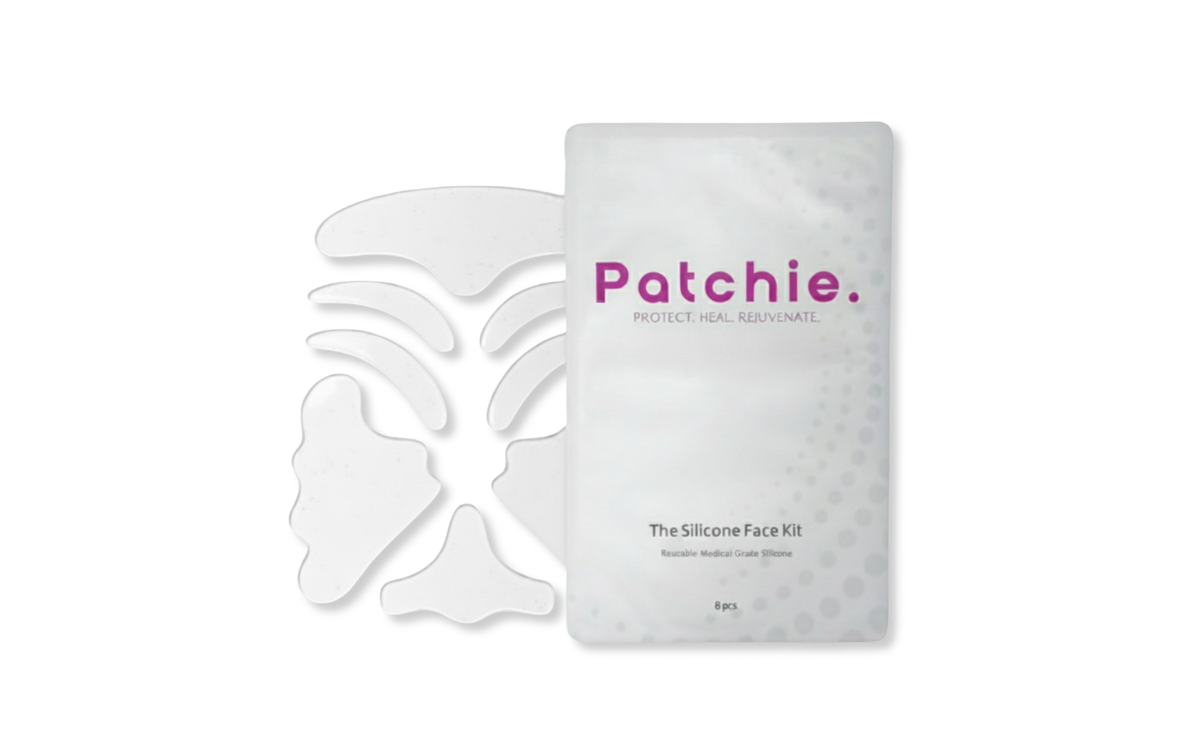
The Patchie Silicone Face Kit is designed to address several common facial skin concerns at the same time.
Fine lines and dehydration lines
When skin is dehydrated, tiny lines can become much more visible.
By reducing moisture loss and increasing hydration in the outer layers of the skin, silicone can temporarily plump these areas, making fine lines appear softer and smoother.
Sleep wrinkles and creases
Side and stomach sleepers can spend hours every night with their face pressed against a pillow.
Your cheeks can be compressed, your forehead can fold and the skin around your eyes and mouth can repeatedly crease.
When we're younger, these lines tend to disappear quickly.
As skin changes with age and becomes less resilient, those creases may take longer to bounce back.
Silicone patches physically cover and support the skin while you sleep, helping reduce the amount of folding and scrunching occurring underneath them.
Crepey-looking skin
Crepey skin can look significantly more noticeable when the skin is dehydrated.
Because silicone helps retain moisture, the skin underneath can appear fuller, softer and less crinkled.
Dull, tired-looking skin
Hydrated skin reflects light more evenly than dry, rough skin.
That smoother surface can give skin a fresher, healthier and more luminous appearance when the patches are removed.
Why silicone is different from creams and oils
Creams, serums and facial oils absolutely have a place in a good skincare routine.
But they work differently from silicone patches.
Most traditional skincare relies on ingredients being applied to the skin to moisturise, condition or deliver specific active ingredients.
Silicone doesn't need to deliver an active ingredient.
Instead, it changes the physical environment around your skin.
A silicone patch creates a continuous occlusive layer over a targeted area, helping trap the moisture your skin already contains and reduce evaporation.
And there is another major difference that a moisturiser can't provide:
physical support.
A cream may moisturise your forehead, but it can't stop your forehead from being pressed into your pillow.
An oil may soften your skin, but it can't physically hold your cheek flatter while you sleep.
A silicone patch can do both.
It helps maintain hydration and creates a physical barrier against repetitive sleep creasing.
That's why silicone patches shouldn't necessarily be thought of as a replacement for skincare.
They're a completely different tool.
Why not just use a really thick moisturiser?
A rich moisturiser can certainly help reduce water loss, particularly when it contains occlusive ingredients.
But it still doesn't create the same structured physical layer across the skin.
Silicone patches remain positioned over specific wrinkle-prone areas for hours at a time.
That means you're not only creating an occlusive environment – you're also helping prevent the skin underneath from folding as freely against bedding.
It's the combination of occlusion + hydration + physical support that makes silicone face patches different.
What is the Patchie Silicone Face Kit?
The Patchie Reusable Silicone Face Kit is designed to cover the facial areas most commonly affected by fine lines, dehydration and sleep creasing.
The kit includes patches for the:
- Forehead
- Under-eye area
- Cheeks
- Smile-line area
- Chin
Apply them to clean, completely dry skin before going to bed.
While you sleep, the silicone helps reduce moisture evaporation while creating a smooth physical layer over the skin.
By morning, the skin underneath can look visibly plumper, smoother and more hydrated.
Why overnight use works so well
One of the biggest advantages of silicone patches is time.
Rather than applying something for ten or twenty minutes and removing it, you're giving the silicone hours to maintain that protected environment.
And those hours happen to be the same hours when your face would otherwise be repeatedly pressing, folding and creasing against your pillow.
That's why silicone face patches make so much sense as an overnight treatment.
You're addressing hydration and mechanical creasing at the same time.
Reusable up to 22 times
Unlike many single-use face masks, Patchie Silicone Face Patches are reusable.
With proper care, they can be worn up to 22 times.
After wearing them, rinse the patches with water and leave them to air-dry with the adhesive side facing upwards.
Once dry, they're ready for your next overnight treatment.
So, do silicone face patches work?
Silicone isn't magic – and it doesn't need to be.
The mechanism is actually remarkably straightforward.
Silicone creates a barrier.
That barrier helps reduce water loss.
Reduced water loss means greater hydration in the outer layers of the skin.
Better-hydrated skin becomes fuller and smoother, helping soften the appearance of fine lines and crepey texture.
At the same time, the physical silicone patch helps hold the skin flatter and protects it from some of the repetitive folding and compression that happens while you sleep.
That's why your skin can look so noticeably different when you peel your Patchies off in the morning.
Less moisture escaping. More hydration retained. Less overnight creasing. Plumper, smoother-looking skin.
Sometimes the simplest skincare science makes the most sense.